

Executing a coordinated AfCFTA implementation strategy is no longer just an abstract political promise for small business owners buried under border delays, trade obstacles, and high currency conversion fees. However, the ambition to fundamentally change this reality took center stage as AfCFTA Secretary-General Wamkele Mene announced a staggering new target: pushing intra-African trade to $230 billion by 2027. The big question at this year’s trade summit was simple: when will these high-level deals actually start making business easier and smoother for the small businesses that power Africa’s economy?
Advancing the AfCFTA Implementation Strategy
The third edition of the Biashara Afrika forum opened on May 18, 2026, at the Palais des Congrès in Lomé, Togo. Jointly organized by the AfCFTA Secretariat and the Government of Togo under the theme “Powering Africa’s Economic Transformation through the AfCFTA,” the event served as a vital center for bringing the continent together. Togolese President Faure Essozimna Gnassingbé officially opened the forum, welcoming over 1,500 participants, including policymakers, international investors, and private sector leaders. The three-day event featured high-level plenaries, deal rooms, and technical workshops covering essential drivers of integration: trade facilitation, digital trade, agribusiness, the green economy, and SME finance.
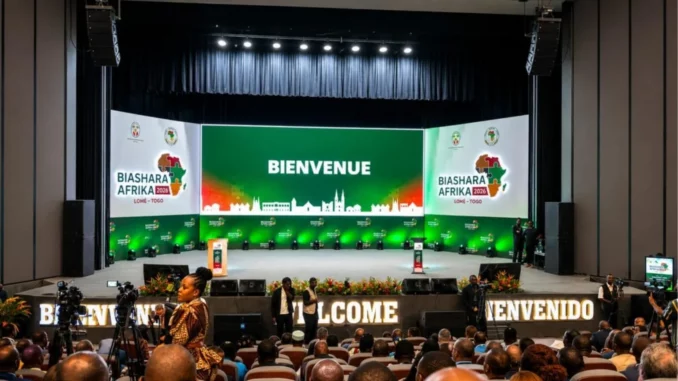
The headline announcement of the forum came from Secretary-General Wamkele Mene, who formally set Africa’s target of reaching $230 billion in intra-African trade by 2027. Achieving this ambitious milestone, which is built on the current $220 billion recorded following a 12.5% recent growth spike, requires an aggressive and sustained acceleration.
Mene emphasized that hitting this target relies fundamentally on private sector mobilization, the widespread adoption of the Pan-African Payment and Settlement System (PAPSS) to ease currency frictions, the acceleration of digital trade protocols, and targeted financial support for small and medium-sized enterprises. Institutionally, the continent’s policy progress is undeniable, with 50 countries having now ratified the agreement. However, intra-African trade still accounts for less than 15% of the continent’s total global trade, showing how difficult it will be to reach the $230 billion target.
At the national level, readiness is gradually improving, with 47 State and non-State Parties having completed their national AfCFTA implementation strategy frameworks. Furthermore, the Guided Trade Initiative (GTI), which is designed to test the operational trade environment, has expanded rapidly from 7 to 39 participating countries, successfully facilitating the issuance of over 1,200 Certificates of Origin for diverse products ranging from ceramics to agricultural goods. Concurrently, PAPSS is actively scaling up transaction volumes to ensure cross-border payments can be seamlessly settled in local currencies.
Despite these institutional advances, a significant implementation gap remains, proving that trade agreements alone are insufficient without localized operational execution. To see the foundational data driving these policy shifts, observers can consult the United Nations Economic Commission for Africa official database to track regional progress. Major barriers persist on the ground:
- Non-Tariff Barriers (NTBs): These continue to stifle movement, though the AfCFTA NTB Online Mechanism is making headway, having resolved 47% of the 30 formally registered complaints as of mid-2025.
- Trade Finance & Rules of Origin: Small and medium-sized enterprises (SMEs) face a significant deficit in trade finance. Furthermore, complex Rules of Origin protocols pose market entry problems, specifically because the rules for critical industrial sectors, such as textiles and automotive manufacturing, remain incomplete, with the agreement rate stalled at 92.43%.
- Infrastructure Deficits: Concurrently, substantial deficiencies in logistics and digital infrastructure continue to inflate transport costs across regions.
Togo as a Strategic Trade Gateway
Lomé’s selection as the host city highlights Togo’s strategic importance as a premier regional trade gateway. Backed by the deepest port on the West African coast and serving as a vital logistics hub connecting landlocked nations like Burkina Faso and Niger, Togo is aggressively domesticating its trade policies. Showcasing its implementation achievements, Togo has seen 457 products approved for preferential treatment, with 65 participating companies and 25 active exporters successfully shipping 282 products, supported by the issuance of 1,973 certificates of origin.

Bridging the Infrastructure Gap for Trade
The success of the agreement relies on the seamless mobility of both goods and people, yet poor cross-border infrastructure currently inflates trading costs by 30% to 40%. This connection was front and center at the Biashara Afrika 2026 forum during a high-level session titled “Connecting Africa – Infrastructure, Ports, Corridors and the Future of African Trade.” To fix this, leaders at Biashara Afrika 2026 emphasized the need for efficient trade corridors and modern ports. Highlighting this shift, Mr. Patient Sayiba Tambwe noted:
“African economic operators are not mere users of trade corridors, but strategic partners with the potential to invest in infrastructure development. The AfCFTA provides the framework to enable that.”
The ultimate success of the market rollout depends almost entirely on SME inclusion. An estimated 50 million MSMEs operate across the continent, yet many remain completely unaware of how to utilize the agreement’s preferential tariffs. To address this, Biashara Afrika 2026 placed a massive focus on empowering women and youth-led businesses to trade more easily and access regional value chains. The forum highlighted the newly developed Protocol on Women and Youth in Trade, which mandates structural support, including border transparency, targeted finance, and capacity building, to protect these vital economic actors who so often anchor our local hospitality and craft tourism markets.
This inclusive push is heavily supported by the digital trade and PAPSS initiatives debated at the forum. PAPSS enables traders to clear cross-border payments in their local currencies in real-time, effectively eliminating the costly reliance on third-party currencies like the US dollar or the Euro. By reducing currency conversion costs and speeding up transaction settlements, digital trade protocols act as the ultimate equalizer. This technology allows a small tour operator or artisan exporter in East Africa to transact seamlessly and instantly with a buyer in West Africa, keeping African capital within the continent.
Positioning the forum within a broader geopolitical lens, President Gnassingbé warned that Africa is navigating a fast-changing world marked by rising protectionism, geopolitical tensions, and the rapid restructuring of global supply chains. In this highly fragmented global environment, no single African economy possesses the critical mass to defend its interests alone. Africa must urgently strengthen its regional integration to build collective economic resilience, shifting away from a historical reliance on external imports toward self-sufficiency and robust regional value chains.
Yet, serious unresolved issues cast a shadow over these ambitions. While progress has been made since the 2024 and 2025 editions of the forum, structural barriers including inadequate cross-border infrastructure, fragmented national customs application, and lingering protectionist mindsets continue to affect full execution.
Looking ahead, three key developments require close monitoring in the immediate future: West & North Africa Strategies. The United Nations Economic Commission for Africa (UNECA) is hosting a regional workshop in Lomé from May 21–22, 2026, focusing specifically on national AfCFTA implementation strategy.
